
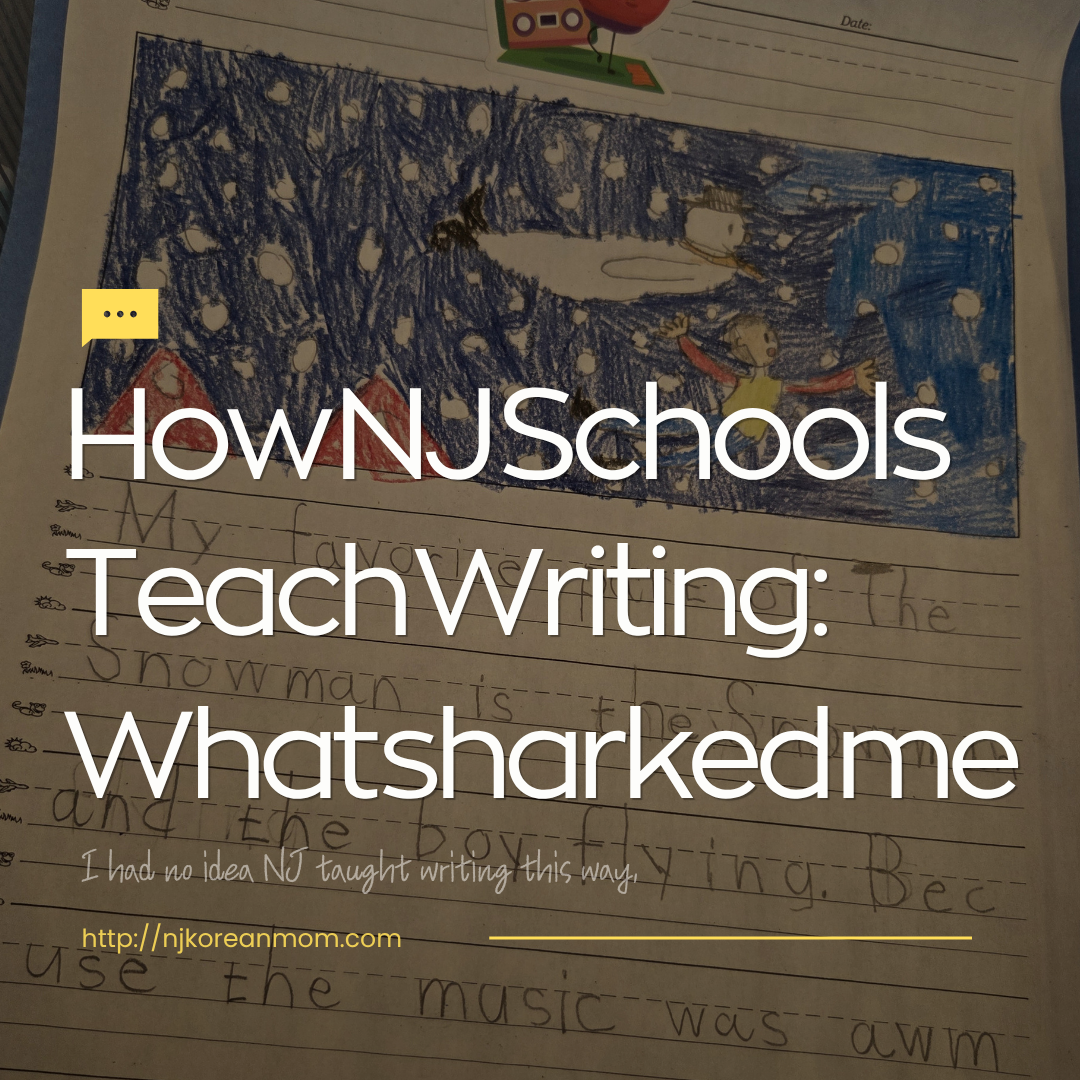
When my daughter started 1st grade in a New Jersey public school, I honestly had no idea what to expect from writing class. Back in Korea, early writing meant copying sentences, memorizing spelling, and getting red marks for every mistake. So when I saw her come home with a drawing and two wobbly sentences — and a sticker on top — I wasn’t sure whether to be relieved or worried.
Turns out, I just didn’t understand the philosophy yet. Now that I’ve been through it with two kids, here’s what early elementary writing actually looks like in NJ public schools — and why it works better than I expected.

Expression first, perfection later
The biggest shift from what I was used to: NJ schools prioritize getting ideas on paper over correct spelling or grammar. From Kindergarten, kids draw pictures first, then write about them. Misspellings are expected. Awkward sentences are completely fine.
This felt uncomfortable at first, honestly. I kept wanting to correct my daughter’s writing. That said, once I saw how freely she expressed herself without fear of being “wrong,” I understood why this approach builds confident writers over time.
Fundations: the backbone of early writing
Many NJ public schools use a program called Fundations (by Wilson Language Training) as their early literacy foundation. In practice, a typical writing lesson looks like this: the class reads a book together, kids draw a scene from the story, and then write one or two sentences about their favorite part.

A common prompt in 1st grade: “My favorite part is ___ because ___.”
Simple as it sounds, that “because” is doing a lot of work. Even in 1st grade, kids are writing opinion sentences with built-in reasoning. My daughter’s teacher explained that this structure becomes the backbone of essay writing in later grades, which made a lot more sense once I saw it in action.
Growing Sentences: grammar without the rules
Another thing that surprised me was how grammar is taught — or rather, how it isn’t taught the traditional way.

Instead of memorizing rules, kids are given a conjunction — because, while, until, but — and asked to write their own sentence using it. No terminology, no drills. Just experimenting with language naturally.
My daughter came home one day with this sentence: “I watch TV while my mom makes lunch.” Grammatically perfect, written entirely on her own. That’s when I stopped questioning the method.
Opinion writing starts earlier than you’d think
One thing that genuinely surprised me: opinion writing begins in Kindergarten in NJ public schools. Kids are asked to share a thought and back it up with at least one reason — even if it’s just a single sentence.

At first, I thought this was too advanced for a 5-year-old. In reality, though, it builds critical thinking from the very beginning. By 1st grade, my daughter was writing things like “I think dogs are better than cats because they play with you” — and feeling proud of it.
What to expect if your child is just starting out
Based on what I’ve seen with both my kids, here’s a realistic picture of what early writing looks like in NJ:
Writing will feel relaxed and creative at first, which can feel unfamiliar if you’re used to more structured systems. Spelling corrections won’t be the main focus in K-1 — and that’s intentional. Your child will be asked to share opinions and draw pictures alongside their writing from very early on. Structure and grammar build gradually, not all at once.
The biggest adjustment for me was resisting the urge to “fix” my kids’ writing at home. Once I let go of that, they both started writing more — and more willingly.
Final thoughts
NJ public schools take a process-oriented approach to writing in early elementary. It’s less about getting it right immediately and more about building the habit and confidence to express ideas on paper.
Once I understood that philosophy, everything clicked. If you’re new to the NJ school system and feeling unsure about what you’re seeing in your child’s writing folder — take a breath. They’re learning exactly what they’re supposed to be learning, just in a different way than you might expect.
Want to learn more about how NJ public schools work? Here are a few posts that might help: