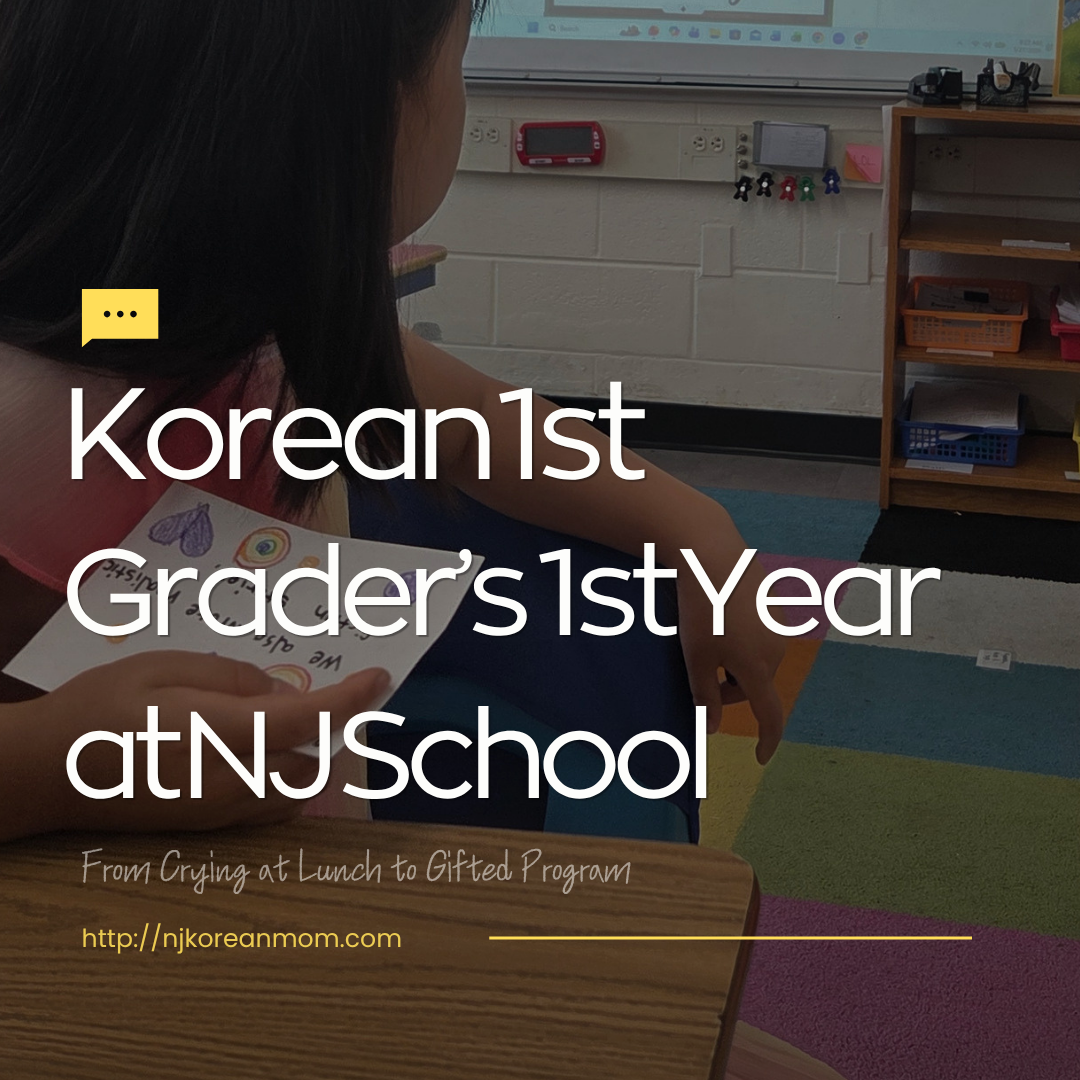
From Crying at Lunch to Gifted Program: My Korean 1st Grader’s First Year at NJ Public School
One freezing cold winter day in 2025, we first arrived in New Jersey straight from Korea, and the very first thing on our list was getting our first daughter enrolled…
One freezing cold winter day in 2025, we first arrived in New Jersey straight from Korea, and the very first thing on our list was getting our first daughter enrolled in a public school. After wading through what felt like endless paperwork — health forms, proof of address, immunization records — I finally got the email: she’d been assigned to a 1st grade class. She walked in that first morning half excited, half terrified. I was probably more terrified than she was.
Six months later, on the last day of school, that same kid was surrounded by her classmates and crying — not because she was scared, but because she didn’t want to leave. She finished the year with nearly all EE’s on her report card, a spot in the gifted program, and more friends than I could keep track of.
When we first arrived, I genuinely didn’t know if she’d be okay. She was more than okay. For the immigrant moms who are right where I was a year ago — wondering if your kid will find their footing — I wanted to write this down.
For a six-year-old stepping into a school in a country she’d never lived in before, the hardest part wasn’t the language — it was the social side.
Here’s something worth knowing if you’re new to the US school system: public school starts from kindergarten at age five. By 1st grade, most kids have already spent a full year together. Friendships are formed, inside jokes exist, and the social landscape has already been drawn. My daughter was joining that world mid-year, as an outsider trying to find a way in.
Her classmates were genuinely kind — they helped her, included her, and never made her feel unwelcome. But kindness and friendship aren’t the same thing, and she felt the difference. The schedule at Fort Lee’s schools is packed, which honestly reflects how strong the district is — but it left little unstructured time for kids to just be kids together. The one window they had was recess, and my daughter didn’t yet know how to walk up to a group and suggest a game. So she stood on the sidelines and watched.
Tell the Teacher — Don’t Wait
I could have sat back and waited for her to figure it out on her own. Instead, I sent her homeroom teacher an email. I kept it simple: I was concerned about how she was adjusting socially, and I wanted the teacher’s perspective.
Her response was reassuring — from what she could see in the classroom, my daughter was interacting fine with her classmates. But she didn’t stop there. She CC’d the school counselor on our email thread, so there was a second set of eyes on the situation if any follow-up was needed.
That one email opened a door I didn’t know existed. If you’re worried about your child, reach out early. Teachers here are generally responsive, and the support system at NJ public schools is more accessible than most immigrant parents realize.
English Matters for Friendships, Not Just Academics
If your child is still developing their English, the language gap can make the social adjustment even harder than it needs to be. At school, make sure they’re enrolled in ESL support if they qualify — don’t opt out of it, thinking they’ll manage. At home, keep working on English alongside them. It doesn’t have to be formal; conversation, books, and even TV shows in English all help.
The social breakthroughs my daughter had later in the year were directly connected to the moments her English caught up enough for her to jump into a conversation, make a joke, or understand what everyone was laughing about at lunch.
Academic Achievements: She Made It Into the Gifted Program
I’ll be honest — academics were the part I was least worried about. Language, yes. Firendships, yes. But my daughter had been doing structured learning since she was young, and I knew that part of her would show up in the classroom regardless of what language she was working in. What I didn’t expect was how quickly it would show.
Her first report card came back with a row of EE’s — Exceeding Expectations — alongside a handful of 3’s (Achieving Expectations). Shortly after the report card was released, I got a handout in her folder: she’d been selected for Project Primary, the gifted program offered within the school. I read it twice in the parking lot just to make sure I understood it correctly.
What the Gifted Program Actually Looked Like
Coming from Korea, I was used to gifted education meaning private academics, weekend programs, and significant family investment. What I found here was something different — and honestly, something better in certain ways.
Project Primary is a pull-out program, meaning kids leave their regular classroom for dedicated sessions over a 10-week period. The projects are genuinely brain-stimulating — less about drilling content and more about thinking differently, working with peers, and solving problems that don’t have one right answer. My daughter came home from those sessions talking more than she had all week.
What struck me most was how systematic it was — built into the public school structure, accessible without any extra cost, and genuinely well-run. For a achild who thrives on challenge, being in a room with highly motivated peers made a real difference. She rose to match the energy of the room.
For immigrant parents wondering whether NJ public schools can stretch a high-achieving kid: in our experience, yes — more than I expected.
Mom Life: The Community I Didn’t Know I Needed
One of the things nobody tells you about sending your kid to a NJ public school is what happens in the pickup line. The first few weeks, I kept to myself. I wasn’t sure how to start a conversation, and honestly, I assumed everyone already knew each other. But over time, faces became familiar. A nod turned into a wave, a wave turned into small talk, and a small talk turned into something that actually felt like friendship.
What surprised me was who those firendships were with. There was a mom from China whose daughter was in the same class. A mom from Russia who knows everything about school life and community facilities. A mom from Columbia who had been through excactly what I was going through — three years earlier — and whose calm confidence was the most reassuring thing anyone said to me all year. A mom from Japan who, on the very first week, asked if I knew where the nearest Korean grocery store was. I did. That was how we met.
None of us spoke the same language at home. All of us were decoding the same school newsletters, the same permission slips, the same report card terminology. There’s a specific kind of bond that forms when everyone around you is equally figuring things out — you drop the performance and just talk.
What I’d Tell a Newly Arrived Immigrant Mom
If you’re just starting this journey, here’s what I wish someone had told me at the beginning:
The adjustment period is real, and it’s okay to let it be hard. Don’t measure your child’s progress by the first month — or even the first three. The turning points tend to come quietly, and then all at once.
Reach out to the teacher early. NJ public school teachers are, in my experience, genuinely accessible. One email can open more doors than months of waiting and wondering.
Find the other immigrant moms. They’re there, in the pickup line, at the school events, in the parent Facebook groups. They know things you need to know, and they remember exactly what this first year feels like.
And finally — trust the process more than the fear. By the end of our first year, my daughter was the one translating things for me.
Cookie Consent
We use cookies to improve your experience on our site. By using our site, you consent to cookies.