
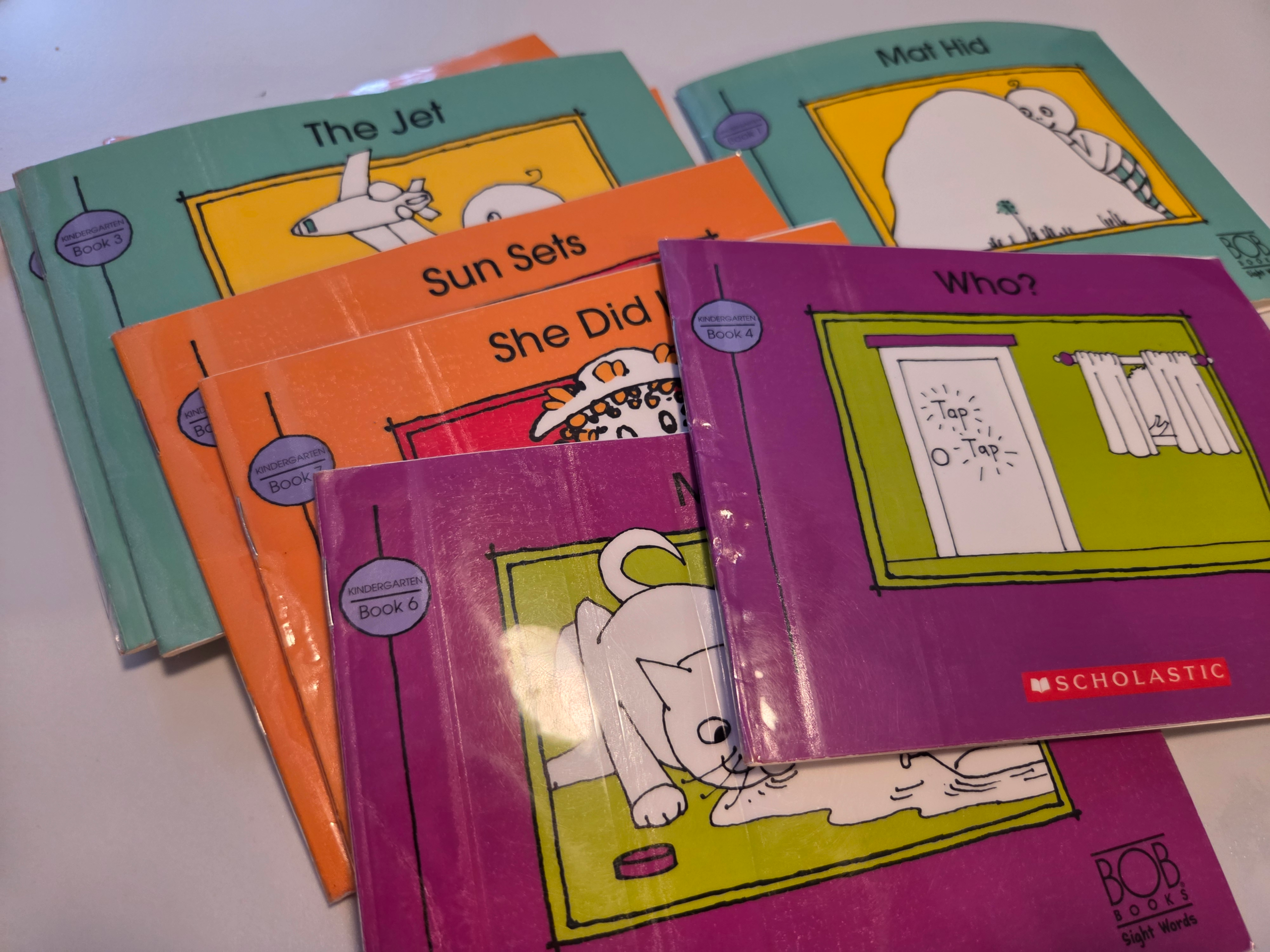
As a stay-at-home mom with a 4-year-old in Pre-K, I’ve often asked myself: “When should we officially start reading?” My child knew the alphabet and could sing the songs, but the transition from recognizing letters to actually reading full sentences still felt out of reach. I didn’t want to push too hard and create a negative association with books, but I also wanted to support that natural curiosity.
That’s when we discovered the Bob Books: Sight Words series at our local New Jersey public library. It wasn’t just a book; it was the “magic key” that unlocked my child’s confidence. If you are navigating the early literacy stages with your Pre-K child, here is a deep dive into why Bob Books are the gold standard for beginning readers.

1. Why Bob Books are Different (and Better)
Many “Level 1” readers you find in bookstores are actually quite difficult. They often contain complex words that a 4-year-old cannot decode yet. Bob Books takes a different approach—the “Small Steps” philosophy.
- Sense of Completion: Each book is only about 12 pages long with one short sentence per page. Finishing a whole book in five minutes gives a Pre-K child an incredible sense of accomplishment.
- Minimalist Design: The illustrations are simple line drawings. This is intentional! It prevents the child from just “guessing” the story based on busy pictures and forces them to focus on the actual letters.
- Controlled Vocabulary: The first few books use only four letter sounds. As your child masters those, a new sound is introduced. This gradual progression ensured my four-year-old never felt overwhelmed.

2. The Power of Sight Words in Early Literacy
While phonics (sounding out words) is the foundation, Sight Words (also known as high-frequency words) are the “glue” that makes reading fluid. These are words like the, is, to, and go—words that don’t always follow standard phonetic rules.
In the Bob Books Sight Words set, each story introduces exactly three new sight words. By repeating these words frequently within a fun context, my child began to recognize them instantly. This “visual memory” is crucial because it allows them to read faster and with more expression, rather than struggling over every single syllable.
3. My NJ Library Hack: Reading on a Budget
One of the best perks of living in New Jersey is our robust public library system. Since Bob Books come in various stages (Beginning Readers, First Stories, Sight Words, etc.), buying every set can get expensive and take up a lot of shelf space.

- The Rotation Strategy: I check out one box set at a time. We keep it for two weeks, read through the 10 small books multiple times, and then return it to “level up” to the next set.
- Checking for Sets: Most NJ libraries keep these in the “Early Reader” or “Parenting” sections. If your local branch doesn’t have a specific set, you can usually request an Inter-Library Loan (ILL) to have it delivered right to your neighborhood branch!
4. A Step-by-Step Guide to Practicing at Home
How do you actually use these books without making it feel like “homework”? Here is the routine that worked for us:

- The 10-Minute Limit: At age 4, attention spans are short. We set a timer for 10 minutes. When it beeps, we stop, even if we are in the middle of a book. This keeps them wanting more.
- The “Point and Read” Technique: I ask my child to use their “pointer finger” to touch each word as they say it. This builds one-to-one correspondence, helping them realize that each group of letters represents a specific spoken word.
- Flashcard Games: Most Bob Books sets include flashcards. We turn these into a game of “Memory” or “Snap,” which helps reinforce the sight words outside of the books themselves.
5. Building a Lifelong Love for Reading
The most “magical” part of this journey hasn’t been the reading itself, but the confidence it gave my child. Seeing a 4-year-old realize, “I can do this!” is a powerful moment. It turns reading from a chore into a source of pride. For Korean-American families like ours, this is also a great way to bridge the gap between English at school and the bilingual environment at home.
💡Tips for Success
- Don’t Rush: If your child gets stuck on a word, just tell them. The goal is to keep the momentum going and the experience positive.
- Read Together: I often read the page first, and then have my child “echo” read it back to me.
- Celebrate: We have a small sticker chart on the fridge. Every book finished equals one sticker. Ten stickers mean a special trip to the park or an extra bedtime story!
[More Tips for Your Child’s Early Literacy?]