
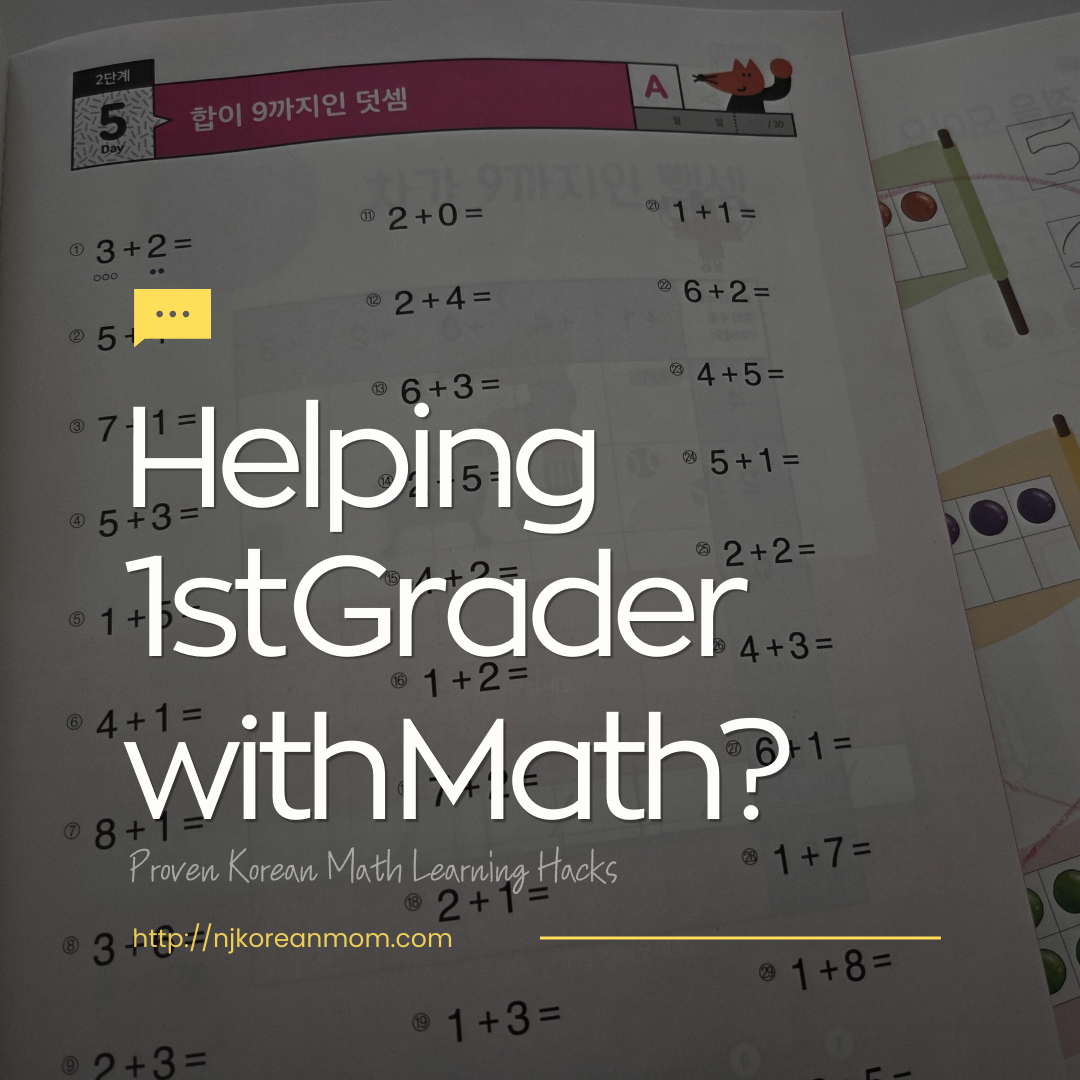
Is your child struggling to keep up with 1st-grade math homework? Many parents in New Jersey find that the transition from simple counting to abstract concepts like place value and word problems can be challenging. All these topics are aligned with the New Jersey Student Learning Standards (NJSLS) for 1st-grade math, and understanding them is key to your child’s success.
In this post, I’ll share proven Korean learning hacks that focus on building a rock-solid foundation in number sense and mental math—strategies that have helped my own children excel in the US public school system.

1. Master the “Friends of 10” (The K-Math Foundation)
In NJ public schools, children learn the “Make Ten” strategy. In Korea, we call this “Friends of 10”. While the concept is the same, the approach is different. We treat these pairs (1 & 9, 2 & 8, 3 & 7, etc.) like a multiplication table—something that should be recalled instantly.

- The Hack: Don’t just explain it; make it a 1-minute daily drill. Ask your child, “Who is the friend of 7?” and have them shout “3!” instantly. This speed is what builds the “mental stamina” needed for more complex addition later.
2. Use “Number Bonds” to Visualize Word Problems
Many 1st graders struggle with word problems, not because they can’t add, but because they don’t understand the structure of the story. Korean math focuses heavily on “Number Tree“, which is the same as the “Part-Part-Whole” model used in the US.
- The Hack: Before touching a pencil, use physical objects like Cheerios or Lego bricks. Show how 5 blocks can be split into 2 and 3. By physically moving objects to create “Number Bonds,” children develop a deep spatial understanding of numbers that makes word problems much easier to decode. This method always works for my four-year-old, who just started learning the basics of addition and subtraction!

3. The “10-Minute Daily Drill” Rule
The US curriculum is wonderful at explaining the “Why,” but sometimes it lacks the “Drill” necessary for fluency. Korean students excel because of a consistent, small habit: 10 minutes of daily calculation.

- The Hack: Don’t overwhelm them with 50 problems. Give them just 10 to 15 problems a day. The goal isn’t just to get the right answer, but to build a habit of sitting down and focusing. This “small but mighty” routine builds incredible math confidence. In fact, according to PBS Parents, 1st graders should be able to solve addition and subtraction problems within 20 by the end of the year, and these K-math hacks will make that goal much easier to reach.
4. Why “Mental Math” Matters in 1st Grade
I often get asked if mental math is still necessary in the age of calculators. My answer is yes! It’s all about cognitive efficiency. By mastering strategies like making a 10, my daughter doesn’t get bogged down by basic calculations. Having this solid foundation from our Korean-style practice has given her a huge head start in her NJ 1st-grade math curriculum; she breezes through her homework with total confidence!
Conclusion: Finding the Balance
The best way to help your child is to combine the creative problem-solving taught in New Jersey schools with the strong foundational drills of the Korean method. By incorporating these simple hacks into your after-school routine, you’ll see your child’s math anxiety turn into math confidence.
What is your child’s biggest struggle in math right now? Let me know in the comments, and let’s figure it out together!
Read more: